
Lucas County Release Paths
A Lucas County release means one custodian's control ended. It does not always mean the person walked into the community. The Lucas County Corrections Center is the main intake and release point for local adult detainees. Courts control bond, dismissal, sentence, and many other exit orders. The Ohio Department of Rehabilitation and Correction controls state-prison custody, while its Adult Parole Authority tracks many people on parole or post-release control. Federal agencies keep separate records. The name of the last custodian therefore sets the correct search route.
A person who leaves the Corrections Center after bond or time served usually drops off a current jail view. Someone transferred to the Corrections Center of Northwest Ohio, an ODRC prison, another county, federal authorities, or immigration custody also leaves the Lucas jail, but remains confined. The booking status, the receiving agency, and the court docket must agree before a community release is treated as confirmed.
- Discharge
- The formal end of a custody or supervision status.
- Time served
- A custodial term completed or satisfied by credited time.
- Detainer
- A request or legal basis for another authority to take custody.
- Community control
- An Ohio court sanction served in the community, often called probation.
Lucas County Release Types
The status phrase matters more than a missing name. A bond or recognizance release ends pretrial detention while the criminal case continues. A dismissal ends a charge or case, though another hold may still prevent release. Time served or sentence expired means the relevant custodial term was met. Parole and post-release control follow an Ohio prison term under state authority. Probation or community control comes from a court. Judicial release is a sentencing-court order under Ohio law.
| Release or exit type | Meaning and next record |
|---|---|
| Bond or recognizance | Local jail custody ends while the case stays open; read the bond entry and pretrial terms. |
| Dismissal | A charge or case ends; check for other cases, warrants, or holds. |
| Time served | The court-ordered local term is credited or complete; confirm the jail transaction. |
| Parole or post-release control | Prison custody changes to APA supervision; check the ODRC detail. |
| Transfer or detainer | The person left one facility but custody continued with another authority. |
| Death | Custody ended, but this is not release to the community. |
Question: Does “out of facility” mean released? No. Lucas records may show only that the person is no longer at that site. A receiving-agency check distinguishes transfer from community release.
Lucas County Release Record Fields
A strong Lucas County release record ties the physical exit to one person, one booking, and one legal basis. Identity fields guard against name matches. Event fields show when custody ended and whether a new authority took over. Public copies may omit medical, victim, juvenile, security, or confidential investigatory material. The sheriff's dynamic booking summary can show a recent Released On date and time, but it is an operational report rather than a promised permanent archive.
| Field | What it shows |
|---|---|
| Full name and date of birth | Identity of the person associated with the custody event. |
| Booking or inmate number | The exact jail or prison record to request and compare. |
| Arrest and booking dates | The intake event linked to the later release. |
| Charges and court | The case authority that may explain bond, sentence, or dismissal. |
| Release date and time | When that custodian recorded the end of physical custody. |
| Type, authority, or order | Why the person left and which court or agency authorized it. |
| Destination or receiving agency | Whether release was to the community, supervision, or another custodian. |
The court record adds legal context. Filed entries can preserve bond, plea, sentence, jail-time credit, judicial release, dismissal, transport, warrant, and later sealing activity after the booking summary changes. A journalized entry is the filed order. It is stronger than a short docket caption, but the jail transaction remains the best evidence of the actual departure time.
Note: When sources conflict, match the booking number, court case, agency, and timestamp before asking the custodian for a corrected or fuller record.
Request Lucas County Release Records
Use the Lucas County Sheriff public-record request for Corrections Center material. Its form accepts party names, an approximate date and time, location, report or incident number, contact details, report type, and a free-text description. A narrow request helps staff locate the right transaction and separates an ordinary electronic record from audio or video work.
- Identify the person by full name, date of birth if known, approximate booking date, and booking or case number.
- Ask for an electronic booking sheet and release or discharge transaction, including the public date, time, type, authority, and destination.
- Add the booking photograph only when it is needed for the same identified booking.
- Request an acknowledgment and estimate. The policy posts no fixed completion deadline.
- If part is withheld, ask for the cited legal basis and all separable, nonexempt portions.
Electronic written records are free when available. The first ten paper pages are free, then paper pages cost ten cents each. Paper pickup is in person by appointment, with cash or money order. Those are the posted sheriff terms, not a promise that every record exists or can be released. Ohio Revised Code §149.43 calls for prompt preparation and production within a reasonable period, which varies with scope, retrieval, and lawful review.
The official sheriff request channel is where a past Lucas County release must be requested when the rolling booking report no longer carries it.
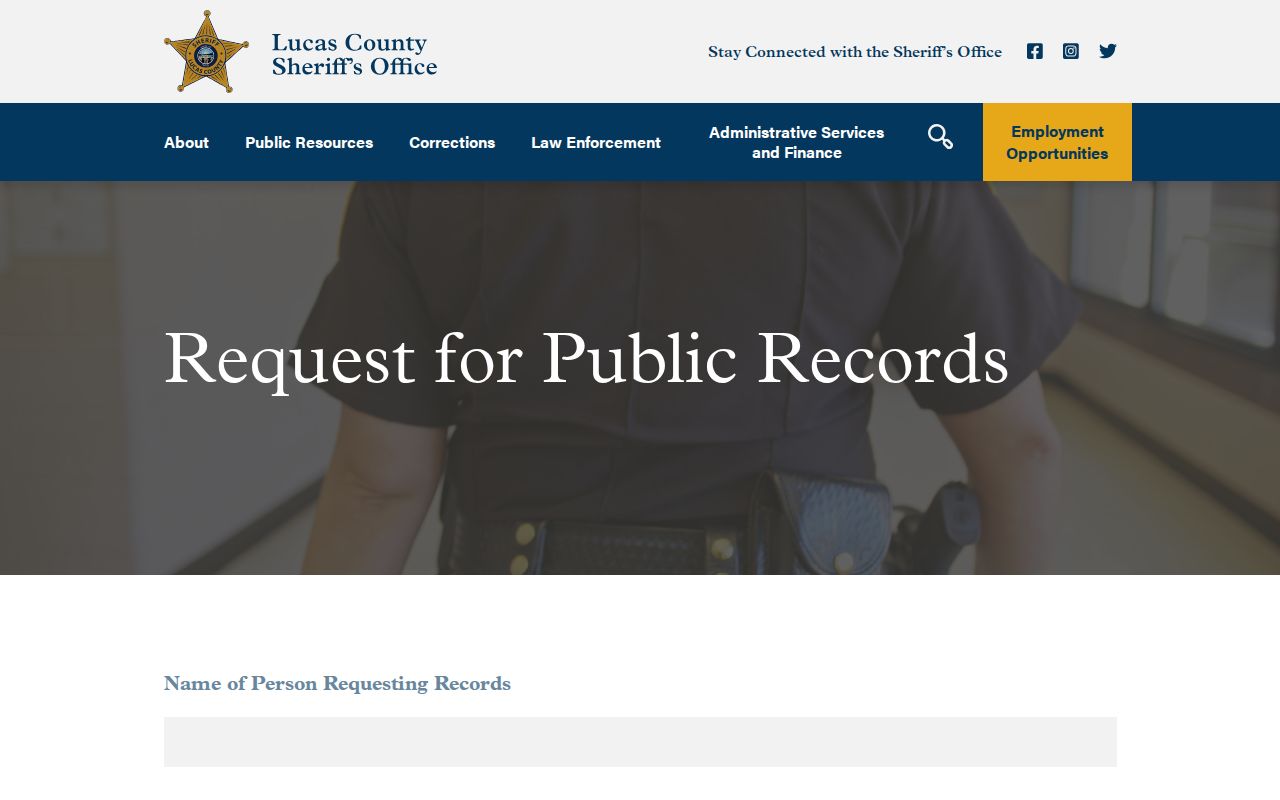
This form is the durable county-jail fallback because it can target one booking and its related release event.
Lucas County Booking Turnover
The sheriff describes the Corrections Center booking area as the primary entry and release point for all detainees. Its annual average measures bookings, not releases or unique people. That difference matters because one person can have more than one booking, and some bookings end in transfer rather than a community exit.
The nine-level jail opened in 1977 and has a recommended capacity of 403. Intake includes screening, fingerprints, a mugshot, and an inventory of property placed in safekeeping. Those steps create the booking anchor used to find the later release transaction. None of these figures should be restated as a count of Lucas County released inmates.
Lucas County Pretrial Release Duties
Legal release from the Corrections Center can come with immediate duties. Lucas County Pretrial Services places assessment officers inside booking around the clock and says they assist the sheriff with releases. A person placed on Supervised Own Recognizance or Monitored Own Recognizance must report at once to Pretrial Services at 1100 Jefferson Avenue. Reporting methods and frequency then depend on the ordered level.
This is not probation or parole. Pretrial release occurs while a case is pending, and the court's conditions continue even though jail custody has ended. The filed bond order shows the legal terms. The booking transaction shows the physical release. When the two are read together, a family can confirm both that the person left LCCC and that court oversight remains in force.
Note: Posting bond or receiving recognizance does not close the criminal case or erase another valid hold.
Lucas County Release Sealing Rules
Ohio's Public Records Act starts with access to records kept by public offices, subject to many exclusions. Medical, victim, juvenile, security-sensitive, and some investigatory material may be withheld. Probation, parole, community-control-sanction, and post-release-control proceeding records are also excluded from the Act's definition in specified circumstances. A public court journal or ODRC status may exist while an internal supervision file does not.
Lucas County publishes local sealing and expungement instructions. Current local directions describe a $50 one-time filing fee for guilty convictions and no fee for dismissed matters. The court holds a hearing. Waiting starts from legal final discharge, not the day a person walked out of jail. Sealing limits ordinary public access, while expungement has a distinct statutory effect. Neither should be described as automatic deletion.
An official record under Ohio Revised Code Chapter 2953 can include the docket, law-enforcement records, fingerprints, and photographs. When a public result disappears after a court order, do not rebuild the record from an old copy. Use the current Lucas court form, and let the record custodian apply the order and any statutory exceptions.
Find Lucas County Released Inmates
Start with the agency that last held the person. County-jail, state-prison, federal, and immigration systems do not share one complete record. For a recent LCCC event, use the sheriff's booking PDF as a timestamped clue. For a Lucas felony case, read the court docket. ODRC becomes relevant only if the person entered state custody or state supervision. VINELink can report a custody change from a participating agency, but it is not a permanent release archive.
- Check the sheriff booking summary's report time and search the exact surname. Read the whole current-status line.
- Open the correct Lucas court docket and read bond, sentence, disposition, transport, and later journal entries.
- If Ohio prison custody appears, search ODRC by offender number or name and use Released, APA Supervision, or Violators at Large deliberately.
- For a federal sentence, check the BOP locator. For an ICE handoff, use the ICE detainee locator.
- Request the release transaction from the sheriff or the precise public ODRC release fields when no live result resolves the event.
A future Ohio prison date requires different reading; the resolved Inmate Release Date page addresses projected dates, credits, and parole eligibility. Post-custody oversight is detailed on the Parole / Probation page.
Lucas County ODRC Release Search
The ODRC Offender Search covers current Ohio prisoners, people under Department supervision, and judicially released people. It does not archive every short LCCC stay. Search by ODRC number when available. ODRC says the number uses six digits with a prefix, and a five-digit number needs a leading zero. Without it, begin with last name, add first name, then narrow by County of Commitment: Lucas.
| Search field | Best use |
|---|---|
| ODRC number | Strongest match when the full prefixed identifier is known. |
| Last and first name | Broad starting point; avoid too many filters at once. |
| County of commitment | Narrows a state case to Lucas, though a multi-county record may list only the first county. |
| Status | Select Released, APA Supervision, Violators at Large, or Incarcerated based on the question. |
| Hearing month | Uses YYYYMM to locate a scheduled Parole Board review month. |
| Residential county or ZIP | Optional narrowing based on last recorded data, not a live location. |
Open the detail and compare the number, date of birth, committing county, and docket. Fields may include status, release or parole detail, supervision start, APA office, sentence components, jail-time credit, and an Expected Release Date/Parole Eligibility Date. APA Supervision is conditional community oversight, not unconditional discharge. Violator at Large reports an alleged supervision status, not a new conviction.
The captured ODRC search screen shows why status filters are central to finding Lucas County released inmates after state-prison involvement.
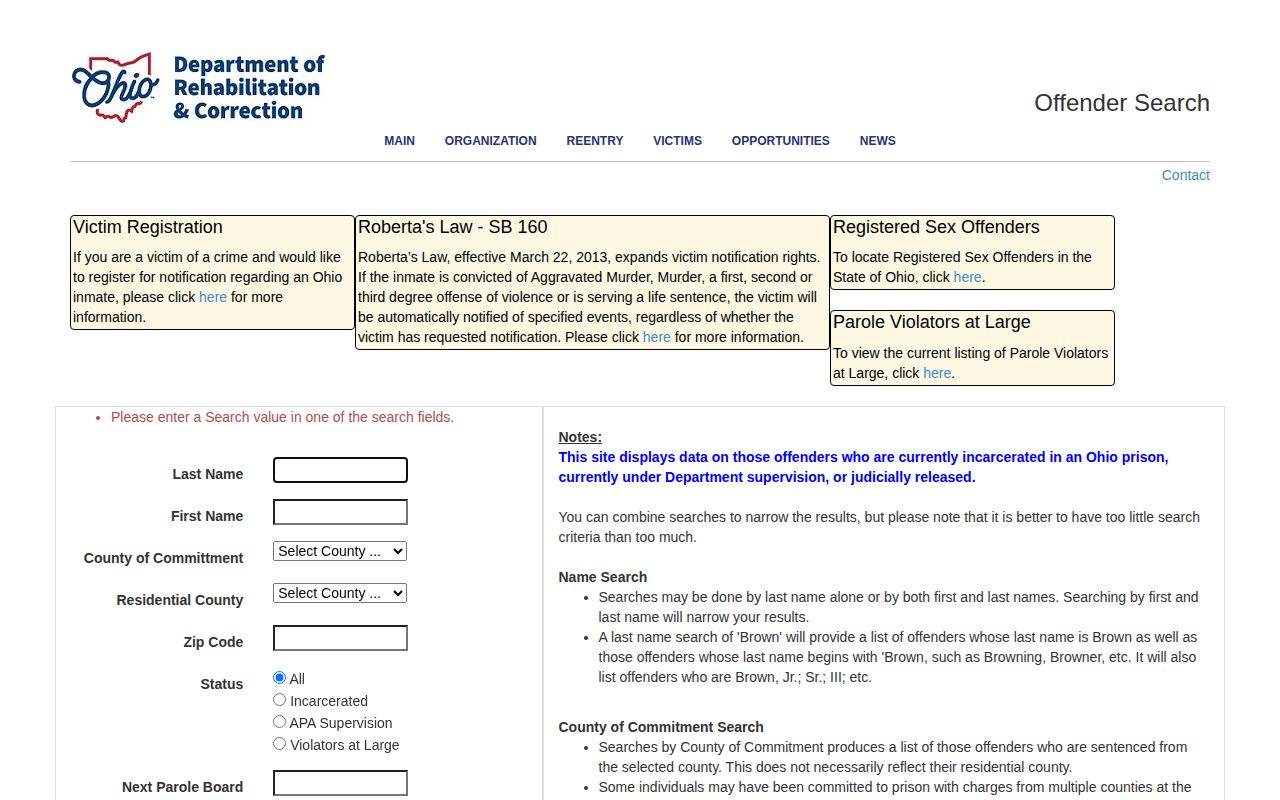
A matching detail still needs comparison with the Lucas docket because ODRC warns that sentence data may be incomplete and addresses are not live locations.
Note: ODRC Central Records handles state records; it cannot certify a county-only jail release that never entered Department custody.
Lucas County Release Court Paths
Lucas County has five adult criminal courts in its Regional Court Services landscape: Common Pleas plus Toledo, Maumee, Oregon, and Sylvania municipal courts. The county Online Dockets landing page routes felony cases. Since January 6, 2026, General Trial Division information has shifted toward re:SearchOH and Justice Case Access, both account-based, as the legacy portal is phased out.
Justice Case Access Smart Search accepts a case number or a name in last, first form. A felony file may retain bond, plea, sentence, jail-time credit, transport orders, release motions, journalized disposition, warrant, and sealing activity. Toledo Municipal Court keeps its own criminal and traffic case search. Other municipal cases belong with their own clerks. One dismissal cannot prove release if another court or agency has a hold.
The captured Lucas County docket routing page illustrates the live transition point a records search should use rather than a saved legacy address.
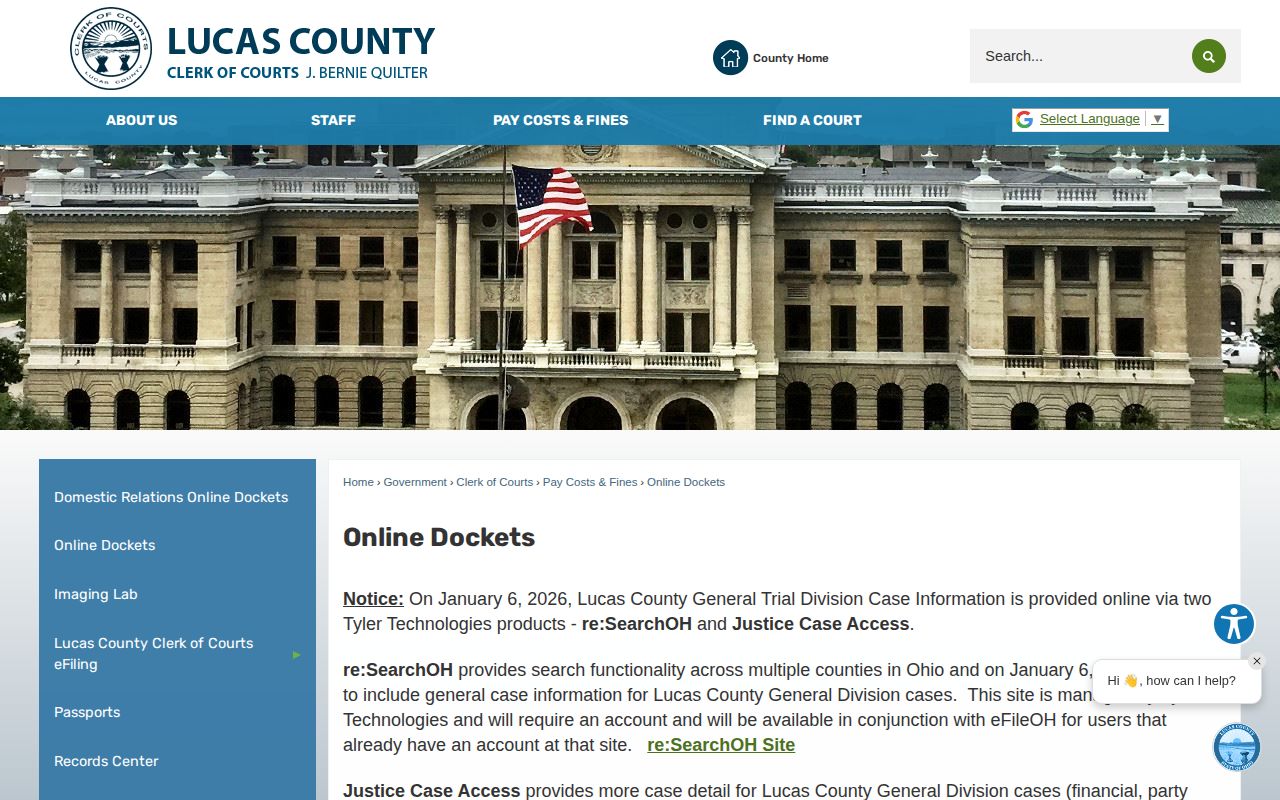
The landing page keeps a release check tied to the correct current court system as local portal access changes.
Lucas County Release Logistics
LCCC's booking area is the official primary release point, but the sheriff does not publish standard release hours, a weekend or holiday schedule, family waiting rules, or an exit door. Do not plan a pickup around a guessed routine. Booking General Information at 419-213-4962 can address current operational questions. The property line is 419-213-4938 because items were inventoried and held during intake.
Release can wait on the court order, identity work, property processing, or a receiving authority. A release timestamp may also mark the end of Lucas custody before an immediate transfer. Main Control at 419-213-4425 can provide operational direction, but staff may route a record question to the Records Section. A written release transaction remains the durable proof.
Lucas County CTF Release Meaning
The Lucas County Correctional Treatment Facility is a court-connected, community-based correctional placement, not an LCCC detention wing. Its current page describes specified adult referrals, sentences of up to six months, and a work-release component. Authorized daily movement does not end custody. Completion or residential discharge may also lead into probation or other community-control terms.
Confirm the change through the sentencing docket and CTF at its current East Central Avenue contact, not through the sheriff booking summary. The program says case managers connect residents with essential and social-service resources. It also says residents may earn “good days,” but publishes no formula. The court and program must supply the adjusted date and exact discharge status.
Note: A move from residential treatment to community control ends one placement, not necessarily the court's supervision.
Lucas County Release Notifications
Ohio VINE and VINELink can provide a custody-status check or alert for a specific record from a participating county jail or ODRC. Select Ohio, search by name or identifier, confirm the reporting agency and identity, then read the current status and timestamp. A released event reflects what that agency sent. It does not supply the court's reason or prove that every hold ended. VINE is strongest before an expected change and may not keep old releases visible.
Federal prison releases belong in the BOP Inmate Locator. A past release date with no facility and a status such as Released or Not in BOP Custody means BOP custody ended, though another authority or supervision may apply. Federal pretrial prisoners can be held for the U.S. Marshals in a contract jail before appearing as sentenced BOP prisoners. PACER, the court, counsel, or the relevant Marshals office may be needed.
An ICE detainer can lead to an agency handoff at the local release point. ICE's Online Detainee Locator System accepts an A-number and country of birth or exact biographical details. Its recent-release coverage is limited, and an LCCC departure into ICE custody is not a community release. No dedicated federal prison or ICE detention center was identified in Lucas County.
Toledo Release Scams and Custody
The City of Toledo does not operate its own detention facility, a point noted by the Ohio Supreme Court. A “Toledo city jail release roster” is therefore the wrong target. City criminal cases may appear in Toledo Municipal Court, while physical custody can be at LCCC or another facility. Match the court case to the actual custodian before treating any status as final.
The sheriff's scam warning says the office will never call, text, or email to demand money for an inmate's bond, release, or program. A family waiting for release should verify payment or bond instructions with the court, clerk, or sheriff through independently found official contact details. Urgency, threats, and a demand for instant electronic payment are reasons to stop and verify.
Lucas County Release Status Comparison
Use the system that owns the custody stage. A current Corrections Center entry answers a county-jail question. A past sheriff transaction documents that jail's exit. ODRC handles state prison and APA status. Federal and immigration agencies answer only for their own custody. Court records explain legal authority but do not replace the custodian's physical release transaction.
Still in LCCC: Check the current booking status, then call the jail for urgent operational confirmation.
Released from LCCC: Look for a recent Released On line and request the historical transaction.
Transferred: Follow the named receiving jail, ODRC institution, federal authority, or ICE record.
Released from Ohio prison: Read ODRC Released or APA Supervision status, release detail, and the matching court case.
Federal custody ended: Use the BOP release date or the responsible federal agency, then check for another authority.
Question: What proves release best? The best pair is the custodian's dated release transaction and the filed court order or state detail that explains its basis. A stale screenshot alone is weaker.
Lucas County Release Facilities
Five adult facilities define the local release map. They do not share one public roster. The primary county jail comes first, followed by county programs, the state prison, and the regional jail used in Lucas transfer records.
- Lucas County Corrections Center: county detainees may leave to the community or transfer; confirm with booking status, court, VINE, and sheriff records.
- Lucas County CTF Work Release Program: temporary authorized movement is not discharge; confirm completion or transfer with the court and program.
- Lucas County Correctional Treatment Facility: a court-connected placement whose residential discharge may lead to continued community control.
- Toledo Correctional Institution: an ODRC prison; use statewide offender status and state records, not the county booking PDF.
- Corrections Center of Northwest Ohio: a regional jail in Stryker; follow its own custody and records channels after a Lucas transfer.
Juvenile detention is intentionally outside this adult workflow because juvenile court and custody information follows different access rules. No separate adult city jail, federal prison, or dedicated ICE detention site was verified within Lucas County.