
Toledo Prison Release Paths
ODRC controls Toledo Correctional Institution. A sentenced person can leave the prison through completion of a term, parole where the sentence is parole-eligible, judicial release ordered by the sentencing court, transitional control, or another lawful state process. Post-release control or parole may follow physical release. In that event, the person is outside prison but remains under Adult Parole Authority supervision.
Movement to a different Ohio prison is not a release. Nor does a scheduled date guarantee a community exit. A detainer can cause ODRC to deliver the person to another authority on the release date. The state record may therefore mark the end of ODRC confinement while a county, federal, or immigration custodian takes control. Read the institution, status, release detail, supervision fields, and any detainer-related record together.
Confirm Toledo Prison Release
The ODRC Offender Search is the correct public lookup. Use an offender number when possible. ODRC numbers have six digits with a prefix; the research notes W for women and A or R for men, with a leading zero when needed. A name search can be narrowed by Lucas as County of Commitment, but that field may reflect the first county in a multi-county record.
- Open ODRC Offender Search and enter the offender number, or begin with the last name.
- Use Released, APA Supervision, or Incarcerated deliberately. Do not assume an absent name proves release.
- Match the number, date of birth, offense, Lucas docket, and committing county.
- Read Status, Institution, release or parole detail, POA/PRD date, supervision start, period, and APA office where shown.
- Compare the result with the sentencing entry and ask ODRC Central Records for the precise public release fields if needed.
The Lucas County release-record search explains how county jail, state prison, and federal sources differ. LCCC's booking PDF cannot establish discharge from Toledo Correctional Institution.
Toledo Prison Release Contacts
Use the current ODRC facility page for Toledo Correctional Institution's address, telephone, and visiting information because those details can change. Release-record questions belong with ODRC Central Records, not the Lucas sheriff. The state search notice supplies the Central Records mailing address.
Toledo Correctional Institution
Operator: Ohio Department of Rehabilitation and Correction
Facility contact: Use the current official facility page
Central Records: P.O. Box 430, Columbus, OH 43216
The official Toledo Correctional Institution page was checked July 31, 2026 and is the source for live facility contact details.
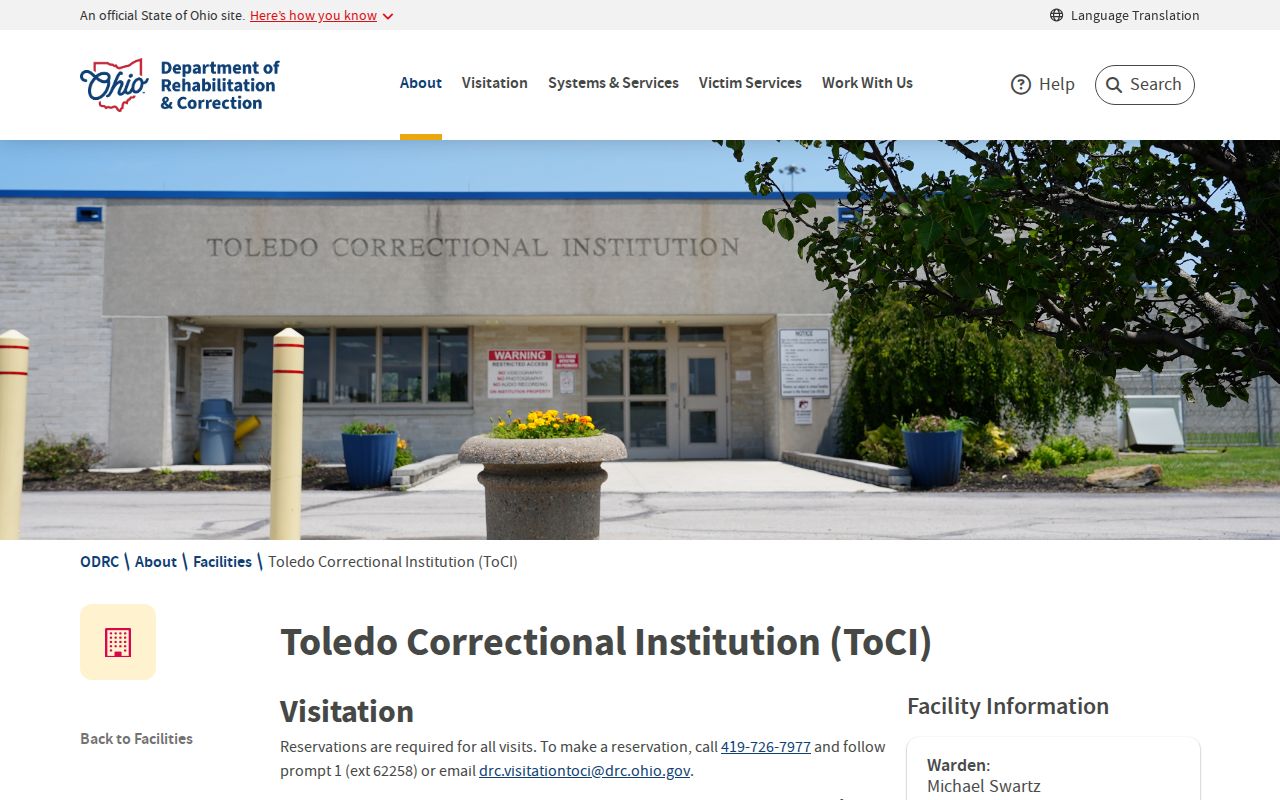
The facility page identifies the prison and its operating agency. Person-specific release evidence remains in ODRC Offender Search and the applicable records response.
Toledo Prison Search Fields
ODRC's detail record carries far more than a location. Fields can include admission date, current institution, status, offenses, Ohio Revised Code section, effective sentence date, jail-time credit, sentence components, committing county, docket, judge, and an offender photo. Not every field appears on every person. A last recorded address is not a current location.
| ODRC field | Release meaning |
|---|---|
| Status | Distinguishes incarcerated, released, APA supervision, and violator-at-large records. |
| Institution | Shows current placement; a new prison signals transfer. |
| Release/parole detail | Appears after release or parole when applicable. |
| Expected Release Date/Parole Eligibility Date | A projected or eligibility field, not always a fixed exit day. |
| Supervision start and APA office | Shows qualifying community supervision after prison. |
ODRC warns that sentence information may be incomplete and updates can lag. Save the access date, use the offender number, and reconcile the Lucas case. A supervision period can arise from a different offense, so do not attach every displayed condition to the Toledo confinement without checking.
Toledo Prison Release Dates
The exact ODRC label is Expected Release Date/Parole Eligibility Date. The slash matters. For a definite sentence it may reflect the calculated end; for an older indefinite sentence it may be an eligibility date that allows review but does not grant parole. Some records also show POA/PRD Date, meaning parole on or after or projected release date.
A date can change after jail-time-credit correction, sentence aggregation, earned-credit award or withdrawal, a revised court order, Parole Board action, a new sanction, or ODRC recalculation. Current Ohio earned credit can allow up to a statutory aggregate cap for eligible activity, but it is not automatic and exclusions apply. The sentencing entry and ODRC computation control the individual case. A detainer can also change the destination without changing the date.
Note: Parole eligibility means the Board may consider release; it is not an order opening the prison gate.
Toledo Prison Discharge Records
ODRC maintains institutional information that includes admission, transfers, and the date, cause, and terms of discharge. Ohio law does not make the entire inmate or APA file public. ORC §5120.21 permits disclosure of selected facts, including identity, convictions, photograph, supervision status, and current or past place of incarceration. Ask for those precise public fields.
A focused request names the full name, ODRC number, Lucas committing county and docket, and seeks the final release or discharge date and type, public sentence computation, or another listed public field. If the public search and judgment conflict, ask ODRC to address its own record and ask the sentencing court for the filed judgment. Neither office should be asked to certify what the other controls.
Toledo Prison Scam Distinction
The City of Toledo does not own or operate a detention facility, as noted in an Ohio Supreme Court decision. Toledo Correctional Institution is a state prison operated by ODRC, not a city jail. The point is especially relevant here because a search for a “Toledo city jail roster” cannot confirm an ODRC prison release. City court records and state custody records belong to different systems.
The Lucas sheriff also warns it will never call, text, or email demanding money for an inmate's bond, release, or program. That warning should not be overstated: the sheriff does not operate Toledo Correctional Institution. Still, a caller who invokes a Lucas jail bond to claim it controls a state-prison discharge is mixing authorities. Verify state release information through ODRC, and review the sheriff's bond scam warning when an unsolicited demand uses local jail language.
Toledo Prison Release Evidence
A reliable state-prison release record starts with the ODRC number. Names can change or collide, while the number links the search result, sentence components, prison placement, and release fields. Match it to the Lucas docket and judge when Lucas County was the committing court. County of Commitment may show only the first county in a multi-county record, so an offender-number match is safer than a county filter alone.
Read status in context. Incarcerated with Toledo Correctional Institution as the institution means present state confinement according to the last update. A different institution generally means transfer inside ODRC. APA Supervision covers parole, post-release control, judicial release under supervision, and other qualifying categories. It confirms release from prison with state supervision, not final discharge from every legal obligation. Violators at Large records an alleged supervision violation or failure to report and is not proof of a new conviction.
For parole-eligible records, examine the next hearing or review month and latest hearing type and result. A future date can mean review occurs before that month, and eligibility never guarantees release. For definite terms, compare the expected date with sentence credit and later court orders. Save the record and access date because calculation and status fields can change.
After physical release, the APA office and supervision start can route verification. Do not assume every Lucas resident reports to one Toledo office because specialized assignments and residence can affect placement. Use ODRC's field-office directory and the office named on the person-specific record. Internal supervision files may be nonpublic even when the public status is visible.
If a detainer controls the destination, search that authority next. An ODRC release date can still be accurate as the end of state-prison custody even though the person does not enter the community. The receiving county, federal agency, or ICE record then governs the next custody stage and ultimate release.
A final discharge is also different from supervised release. When the public detail shows no active supervision, confirm whether the displayed status reflects the whole ODRC record and compare it with the latest court action. If the record shows APA Supervision, use the public office field for routing but do not seek protected supervision notes. Questions about a possibly wrong sentence or release field should go to ODRC Central Records with the offender number and docket. Questions about what the judge ordered belong to the sentencing clerk. Keeping those roles separate matters because ODRC computes state custody under the judgment, while the court maintains the authoritative filed order. A county booking record cannot resolve either issue for Toledo Correctional Institution.