
CCNO Release Destinations
Corrections Center of Northwest Ohio is a regional jail in Stryker, Williams County. It is not physically in Lucas County. It still matters to a Lucas County release search because local court, jail, and work-release materials can identify CCNO as a transfer or placement destination. The moment of transfer ends custody at the Lucas facility, but confinement continues at CCNO.
An ultimate CCNO departure may return the person to the community after bond, a court order, or completion of the relevant term. It can also send the person to another jail, ODRC, a federal authority, or an immigration custodian when a valid record requires that handoff. The CCNO release transaction should identify the date and type. The originating court explains the legal basis. A receiving-agency record resolves any continued custody.
Confirm a CCNO Release
Begin with CCNO's official inmate and contact channels. Then link the correct person to the Lucas case or placement that produced the transfer. Similar names are not enough. Use the booking or facility identifier, date of birth where public, case number, booking date, and sending agency.
- Open the official CCNO site and use its current inmate or contact route.
- Match the person to the Lucas booking, court case, or work-release transfer record.
- Read the CCNO status and ask whether departure was community release or transfer.
- Check the originating court for bond, sentence, transport, or release orders.
- Request the CCNO release transaction for the final exit, including the receiving agency when public.
The Lucas County released-inmate search supplies the fallback path for ODRC, federal, and ICE custody. A person who left CCNO for state prison must be searched in ODRC, not in the Lucas sheriff's booking report.
CCNO Release Contact
CCNO maintains its own contact and records practices. Because the research source does not establish a fixed phone number, street address, or office schedule suitable for evergreen use, the current official site should control those details. This avoids routing a request through LCCC or publishing an unsupported contact.
Corrections Center of Northwest Ohio
Stryker, Williams County, Ohio
Facility type: Regional jail
Contact and records: Use the current CCNO official site
The CCNO regional jail site was checked July 31, 2026 and is the source for current contact and inmate-service routing.
The official site establishes CCNO as the proper custodian. Lucas County offices can explain the sending case, but they cannot replace CCNO's final release record.
CCNO Regional Jail Role
A regional jail serves participating jurisdictions rather than one county alone. That structure makes source matching important. A Lucas court can remain the case authority while CCNO holds the person outside Lucas County. The sending agency, court, and custodian answer different questions. The court tells what was ordered. CCNO records physical custody. A later receiving agency records the next stage.
| Observed event | Where to verify |
|---|---|
| LCCC or CTF transfer to CCNO | Sending record plus CCNO intake |
| Bond or court release at CCNO | Originating court order plus CCNO release transaction |
| CCNO to ODRC | ODRC Offender Search and state record |
| CCNO to another county | Named receiving jail |
| CCNO to federal or ICE custody | Named federal locator, court, or agency |
No result in the Lucas booking PDF after transfer is expected. That operational report does not become a record of later CCNO custody. Keep the chain of identifiers from the original Lucas case through each handoff.
CCNO Release Record Request
Ask for a narrow release transaction tied to one person and one confinement. Provide full name, the CCNO identifier if known, approximate admission and release dates, sending jurisdiction, and Lucas case number. Request the public release date and time, release type or authority, and destination or receiving agency if releasable. A broad request for every internal jail record may add delay and protected material without improving the answer.
The Lucas court docket remains important. A bond entry, dismissal, sentence, transport order, or later warrant can explain why CCNO acted. When the docket and jail record conflict, compare timestamps and identifiers. Obtain the filed journal entry rather than relying on a short docket caption. Ask each custodian to correct or explain its own record.
Note: “Not found” at LCCC after a CCNO transfer is consistent with continued regional custody and does not prove release.
CCNO Detainer Release
A detainer can turn a scheduled jail release into a handoff. Ohio Administrative Code provides a state-prison example of release to a detaining authority, and the same core distinction matters at a regional jail: the first custodian's legal basis ends, yet another authority receives the person. The destination field is as important as the release date.
The Ohio release-to-detainer rule shown below governs ODRC rather than CCNO. It is included to clarify the state handoff concept, not to impose ODRC procedure on a regional jail.
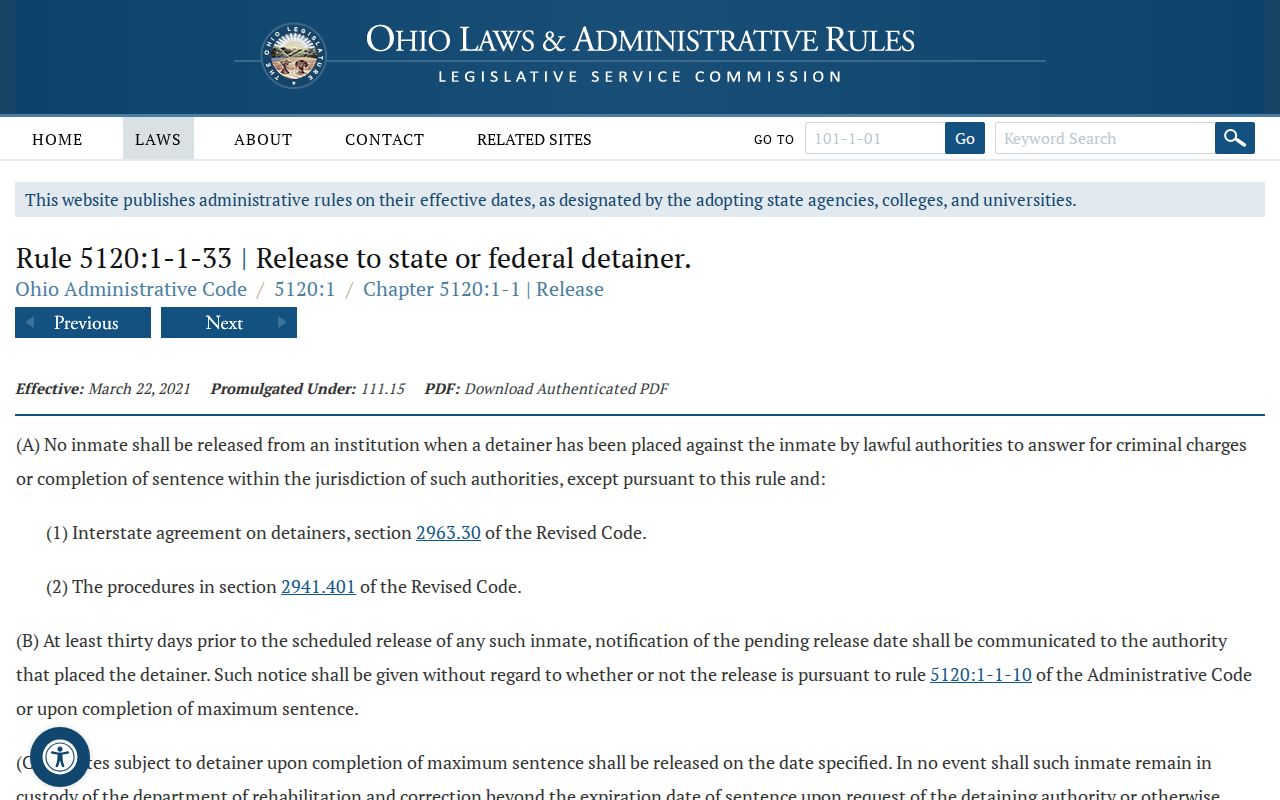
If CCNO identifies ICE, a county warrant, ODRC, or federal custody, use that specific receiving system. A later release must be proved by the agency that then held the person.
Toledo Roster Scam Warning
The City of Toledo does not own or operate a detention facility, as noted by the Ohio Supreme Court. That point helps prevent a common routing error. A Toledo Municipal Court case may result in custody at LCCC or CCNO, but there is no city jail roster that can substitute for either facility's record.
The Lucas County sheriff also warns it never calls, texts, or emails demanding money for an inmate's bond, release, or program. The warning should be applied carefully because CCNO is independently operated and outside Lucas County. Still, a caller who claims a “Toledo city jail” payment will free a person from CCNO is combining the wrong entities. Use the official Lucas scam warning for the local safeguard, then confirm any claimed CCNO or court charge through each agency's published channel.
CCNO Release Evidence Chain
Build the record from the sending event forward. A Lucas booking summary, CTF record, work-release document, or court transport order should identify why the person went to CCNO. Preserve the sending date, case number, and any booking identifier. Next, match the CCNO intake. Finally, obtain the CCNO departure type and destination. This chain prevents a gap between disappearance from one system and appearance in another.
Each source has a limit. The Lucas court can prove the judicial order but may not record the exact minute of jail departure. LCCC or CTF can confirm transfer out but cannot certify what CCNO later did. CCNO can document its own release transaction but not rewrite the originating judgment. A receiving agency controls the custody facts after a later handoff.
When the release is to the community, compare the CCNO transaction with the court's bond, sentence-completion, dismissal, or other release authority. If conditions continue, the docket may name probation or pretrial duties. Those conditions are distinct from physical confinement. When the event is a transfer, record the destination and continue the search rather than labeling the person released.
ODRC is the correct next channel after a state-prison handoff. Search by offender number when available and read the institution and status. BOP covers sentenced federal custody, while the U.S. Marshals Service can control federal pretrial transport without offering the same public historical locator. ICE's locator has limited recent-release scope and should be used only when the record identifies immigration custody.
A precise CCNO records request should avoid speculation. Ask for the release date and time, type or authority, and destination for the named confinement, subject to public-record limits. Include the Lucas case details that connect the person to CCNO. If a field is withheld, ask for the legal basis and the separable public portion. Keep the agency response with the court order so the final conclusion can be traced.
Older Lucas work-release material deserves special care. It described circumstances in which some municipal-court participants could be sent to CCNO, but it does not establish current CCNO admission policy or prove that any named person was transferred. Use it only to understand why the regional jail may appear in an older file. The actual docket, transport order, and CCNO intake must establish the event. Likewise, a refund or program closeout from the sending placement is not proof of community release from CCNO. Ask for the regional jail's own final transaction. If the person later appears in another system, compare dates so a transfer is not mistaken for a gap in custody.