
Lucas Projected Versus Actual Release
A projected date is a calculation or eligibility marker. An actual release is a completed custody transaction. The distinction is sharp in Lucas County because the same person may appear in a court docket, the Lucas County Corrections Center booking summary, and an ODRC detail at different stages. A court may authorize release before staff finish processing it. A jail may hand the person to another authority rather than the community. ODRC may show an expected date that later moves.
A pretrial detainee usually has no sentence-based date. Bond, recognizance, dismissal, a hearing, or a new hold can control the next event. A sentenced jail inmate begins with the court's stated days and certified jail-time credit, but the jail applies the actual computation and later orders. A state prisoner may have an Expected Release Date/Parole Eligibility Date or a POA/PRD Date. Those combined labels demand context.
Note: A release date can become a transfer date when another county, ODRC, federal authority, or ICE assumes custody.
Find a Lucas County Release Date
First classify the custody. The Lucas County Corrections Center is mainly a pretrial jail. Its rolling booking summary may show a past Released On timestamp, but it publishes no future-release calculator. Toledo Correctional Institution is an ODRC prison, so its sentenced population belongs in the statewide offender search. The Correctional Treatment Facility and work-release program require the program and sentencing court because their public page supplies no inmate date tool.
- Confirm the facility and case. Use the booking number, ODRC number, and docket rather than relying on a name alone.
- For state prison, open the ODRC Offender Search. Search by number when possible, or narrow a surname with first name and Lucas as county of commitment.
- Open the matching detail and read status, sentence components, jail-time credit, expected release or parole eligibility, POA/PRD, and hearing fields together.
- For a county sentence, read the filed Lucas court judgment and later modifications, then ask Booking or the Sheriff's Records Section for the jail's current calculation.
- For CTF or work release, ask the program and court for the adjusted completion or discharge date. Do not import a state-prison formula.
- On the date itself, confirm the custody event and destination. A scheduled handoff is not community release.
The Lucas County release-record search explains how to pair the final transaction with the court order when a projected date has passed.
Lucas ODRC Release Date Fields
ODRC's public detail does more than show one date. It may present admission, offenses, effective sentence date, jail-time credit, minimum and maximum components, committing county, docket, expected release or parole eligibility, next hearing, POA/PRD, supervision start, APA office, and status. Not every record has every field. Verify that the committing docket matches the Lucas judgment before using the date.
| ODRC field | How to read it |
|---|---|
| Status | Incarcerated, Released, APA Supervision, or Violator at Large sets the present ODRC context. |
| Expected Release Date/Parole Eligibility Date | May be a calculated term end or the first point for parole consideration. |
| POA/PRD Date | POA means parole on or after; PRD means projected release date. |
| Latest hearing result | Shows a person-specific Board review type and abbreviated result where applicable. |
| Supervision fields | Show whether release may continue under APA and which office is listed. |
The ODRC definitions screen gives the official POA and PRD meanings.
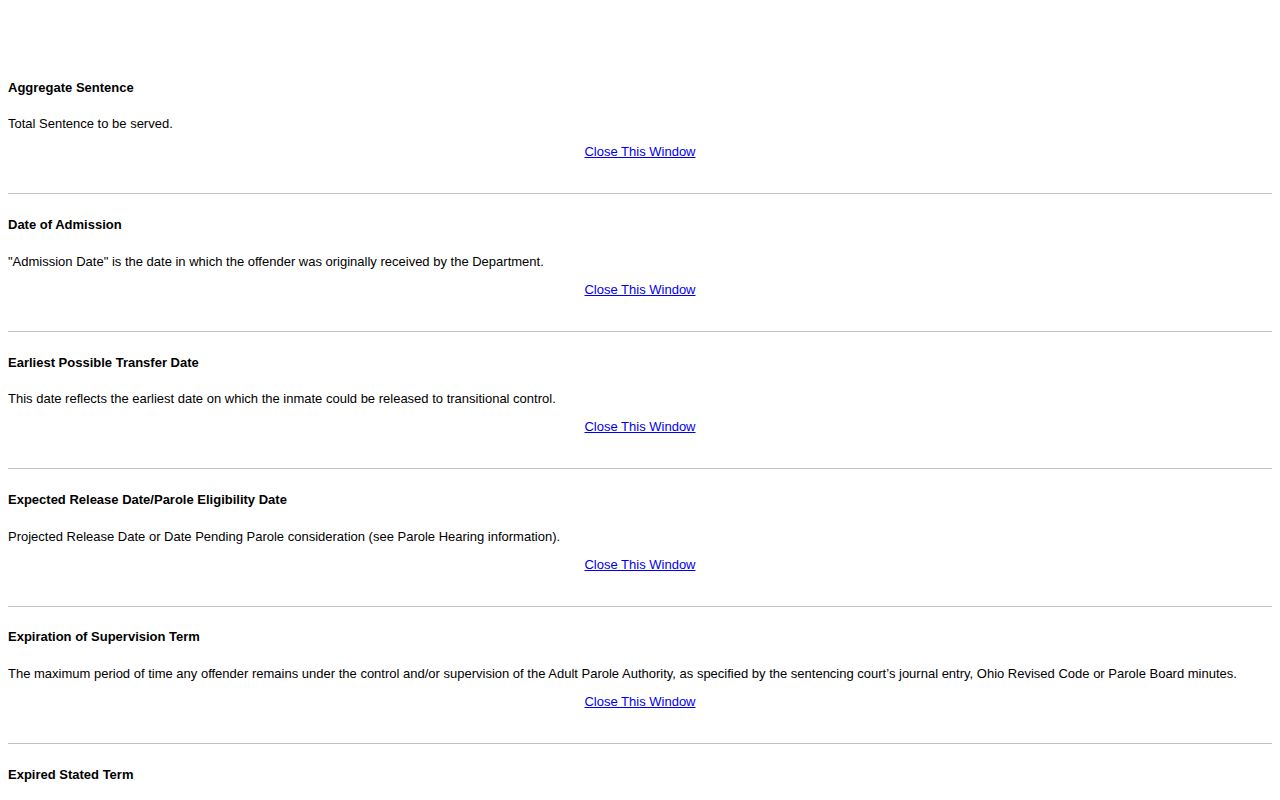
The combined field can describe different legal paths, which is why its label should be saved with the access date rather than reduced to a promise.
Ohio Credit on Lucas Release Dates
Ohio does not impose one rule that everyone serves exactly 85 percent. Current ORC §2967.194 permits eligible people to earn days of reduction for qualifying program and activity participation during confinement on or after April 4, 2024. The statute sets monthly rates that vary by eligibility and an aggregate cap of up to 15 percent of the prison term. Many offenses and sentence types are excluded, and eligible people may earn less.
Time before that date can fall under former ORC §2967.193. A sentence crossing the boundary can reflect both regimes. Jail-time credit under ORC §2967.191 is a different concept: it credits qualifying prior confinement against the stated term. Neither category should be applied with casual arithmetic to a public sentence line.
Old-law parole, definite terms, qualifying indefinite terms, judicial release, and transitional control use different law. ORC §2967.271 governs presumptive release and possible continued incarceration for qualifying indefinite sentences. Judicial release under ORC §2929.20 is a court decision, not earned-credit math. Parole eligibility under ORC §2967.13 means the Board may consider release, not that it must grant it.
Note: “Up to 15 percent for eligible earned credit” is accurate; “everyone gets 15 percent” is not.
Why Lucas Release Dates Change
A date can move after new information reaches the custodian. The change may be mathematical, judicial, administrative, or tied to the destination. Compare a saved earlier result with the current detail and the filed court entry before treating the change as an error.
| Factor | Possible effect | Where to confirm |
|---|---|---|
| Jail-time credit correction | Changes credited days and the computed end | Court judgment and ODRC sentence fields |
| Earned credit awarded or withdrawn | Moves an eligible prison date within statutory limits | ODRC computation or public release facts |
| Amended order or judicial release | Changes the sentence or authorizes an earlier community move | Filed Lucas County court entry |
| Parole Board action | May grant, deny, or defer a parole-eligible release | ODRC hearing type and result |
| Additional sanction or term | Can extend the custody calculation | Agency detail and underlying order |
| Detainer | Keeps the date but changes release into a handoff | ODRC, jail, and receiving authority |
A last recorded address is not proof of location after release. ODRC also warns that a public sentence list may be incomplete. Use the offender number and Lucas docket to request a focused correction or record from Central Records when a material conflict remains.
Lucas CTF Good Days
The Lucas Correctional Treatment Facility creates a local calculation trap. Its current court program page says residents may earn “good days” that can permit early release, but it publishes no formula, cap, or calculation method. That statement does not authorize use of ODRC's prison earned-credit rates at CTF.
Ask CTF at 419-725-6228 for the adjusted program date and inspect the sentencing docket for any later order. The facility is court-connected and accepts specified adult referrals, including sentences described as lasting up to six months. Residential discharge can still be followed by probation or community control, so the program end should not be called an unconditional case discharge.
This Lucas County distinction controls when a CTF resident asks when release will occur: use the local program and court computation, not a statewide shortcut. The same caution applies to work-release movement. Permission to leave for an approved purpose is not release from custody.
Lucas Jail Release Date Checks
The LCCC booking summary is backward-looking. The sheriff's Corrections Center page says it refreshes every four to six hours and selects a roughly three-day booking interval. Some entries show a precise Released On timestamp. That can confirm a recent physical exit, but it is not a future calculator and can omit someone booked before the report interval.
For a local sentence, locate the sentencing entry, stated days, certified jail-time credit, and any modification. Then ask Booking at 419-213-4962 or submit the sheriff's records form for the actual release transaction. A court date alone does not certify the hour staff completed release. If the status says transfer or another hold is present, follow the receiving agency.
Pretrial Services can also separate legal authorization from continuing duties. Officers work inside LCCC booking and assist with releases, while people placed on supervised or monitored own recognizance must report to Pretrial Services. That reporting condition does not turn the person into an ODRC prisoner or establish a sentence end.
The court side matters just as much. Lucas County's Online Dockets landing page routes felony cases to the current General Division systems, while municipal cases may belong to Toledo, Maumee, Oregon, or Sylvania. Read the filed order for bond, sentence, jail-time credit, judicial release, or a later modification. Then compare that legal authority with the jail's physical release entry. If the two dates differ, ask for the public transaction rather than estimating an exit time from the number of days in the judgment.
Confirm Lucas County Release
Use the date field for planning and the completed agency event for proof. For a participating county-jail or ODRC record, the Lucas County VINELink release check can provide an alert. Registration is prospective and person-specific. It is not a sentence calculator or a list of all past releases.
When an alert arrives, return to the sheriff or ODRC record. Match the agency, timestamp, and identity. Then check the court and any receiving authority. For state prison, a status of Released differs from APA Supervision. For county jail, Released On differs from Deactivated or transferred. For federal custody, use BOP or the agency named in the local hold.
A sound conclusion stays narrow: the date shown by ODRC on a stated access date, the release transaction recorded by LCCC, or the discharge order filed by the court. Save the field label, status, and access date because a later calculation can replace the public value. If the public field is unclear, request the final release date and type from ODRC Central Records at P.O. Box 430, Columbus, OH 43216, or the corresponding Lucas County jail record. That preserves the difference between an estimate and what happened.